Beasybox · 2026 · Case study
BBOX, a Workspace Built Around the Client
I took the new Beasybox platform for consulting firms from research to code: every meeting, delivery and client request ends up as a task on one board
- Role
- Product Designer
- Company
- Beasybox
- Year
- 2026
- Scope
- Clients, meetings, deliveries, tasks, portal
Tags: Product Design, Information Architecture, B2B SaaS
Overview
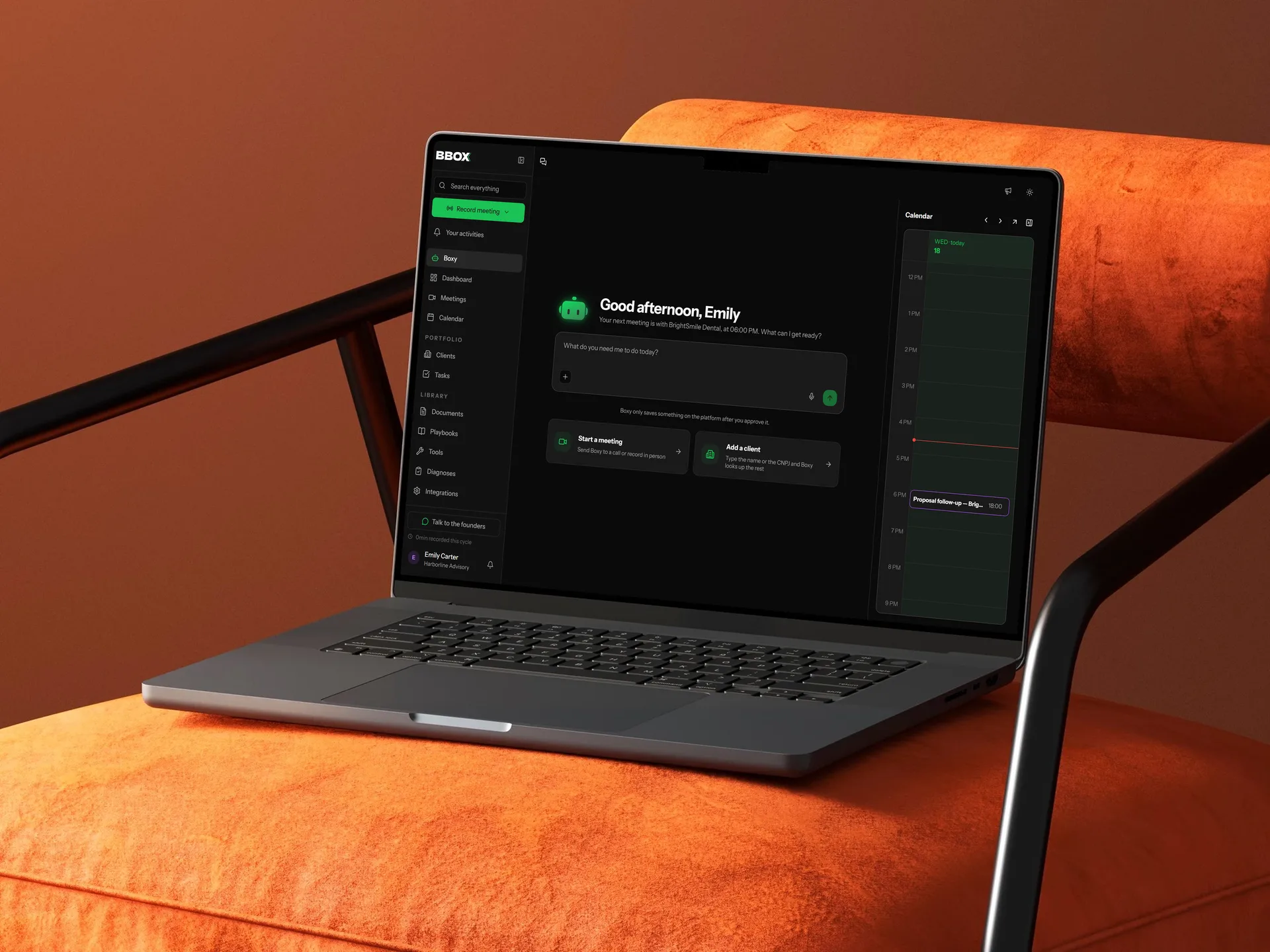
BBOX is the workspace of a consulting firm. Everything a consultant does for a client lives in one place: the meetings, the deliveries and their tasks, the documents, and what the client sees in their own portal.
It answers the question a consultant asks about every client, every morning: where do we stand, and what comes next?
Five partner consultants tested the platform with us, and we collected their feedback directly from them.
My role
We were a team of three: two developers and me as the product designer. I led more than half of the 100+ interviews with consultants, and I owned every feature in this case: how each one works, its flows from start to end, and its implementation in code with Claude Code.
Context
In early 2026 we interviewed more than 100 consultants to understand their pains and how a digital platform could solve them. The main ones were:
- Connecting what was said in a meeting to the start of the work, and to handing tasks to the team.
- Repeating and managing the team's tasks.
- Following how each client evolves.
The same research showed that few consultants were really using what artificial intelligence could do for them.
- 100+: consultants interviewed in early 2026
The idea
The client is the unit of a consultancy's work, so every part of the product answers to it. A meeting belongs to a client, a delivery is made for a client, a request comes from a client, and each of them ends up as tasks on the same board.
Diagram: a meeting, a delivery and a client request each put tasks on one board. A task moves from To do to In progress, where an AI agent takes it, then to In review, where a person approves it. The result reaches the Client 360 timeline and the client portal.
Evolution
Beasybox's first platform was built in Lovable. In August 2026 we rebuilt it from scratch as BBOX, starting with meetings: the first commits connected Google Calendar and sent a bot to record the calls.
- Aug 2026: The rebuild starts with meetings: calendar sync and a bot that joins the call. The client pipeline and the first client portal follow in the same month.
- Sep 2026: Deliveries and playbooks, with playbooks created from a file the consultant already has. Requests go both ways through the portal, and Claude connects to BBOX.
- Oct 2026: A home built around Boxy, AI agents that execute tasks, the Client 360 with its timeline, approvals through the portal and the import of the old platform's clients and meetings.
- Nov 2026: The design system in code across every screen, and a light theme.
Clients
The client at the center
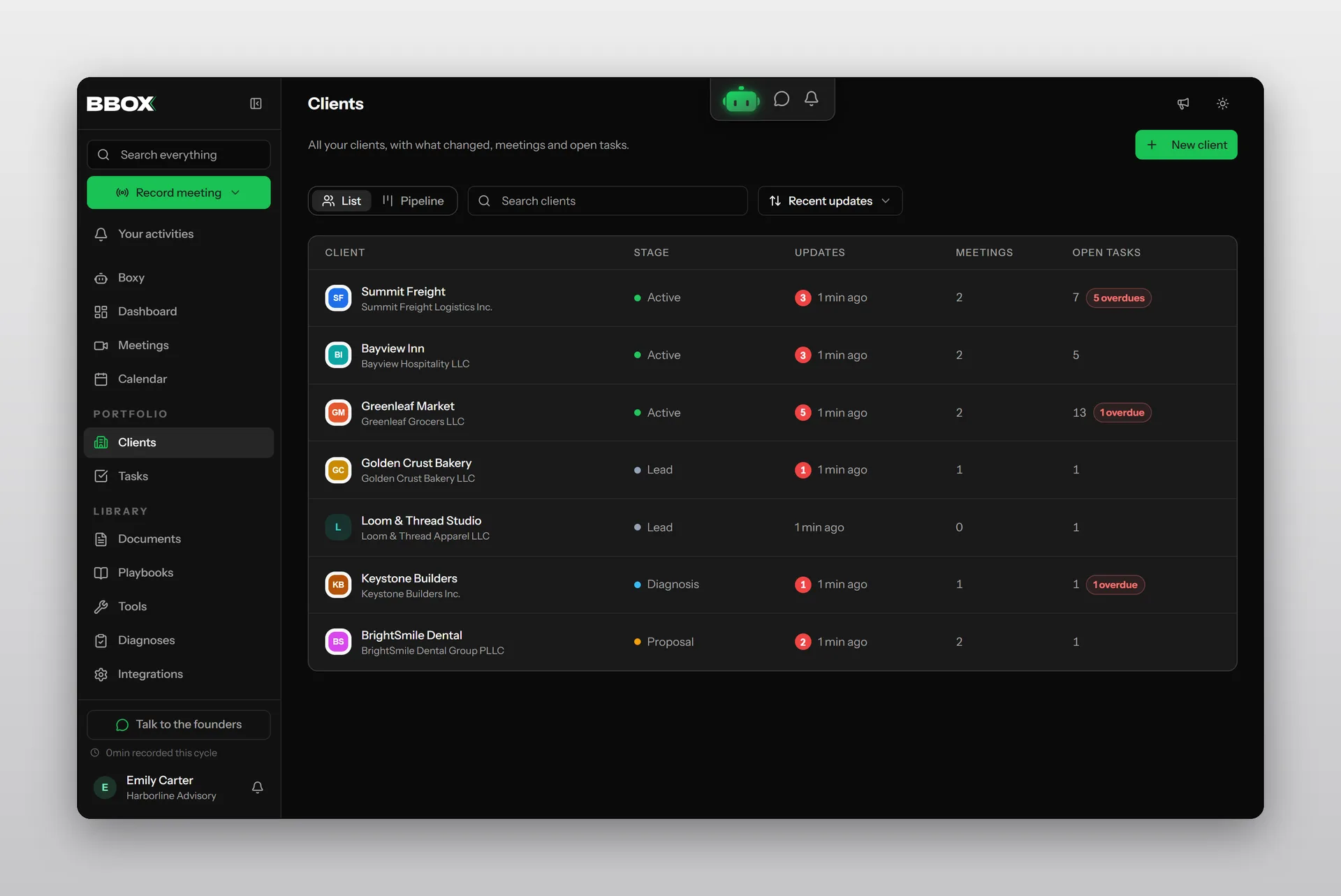
The client list shows every client with its stage, recent updates, meetings and open tasks, and a Pipeline view sits next to the list for clients still in the sales stage.
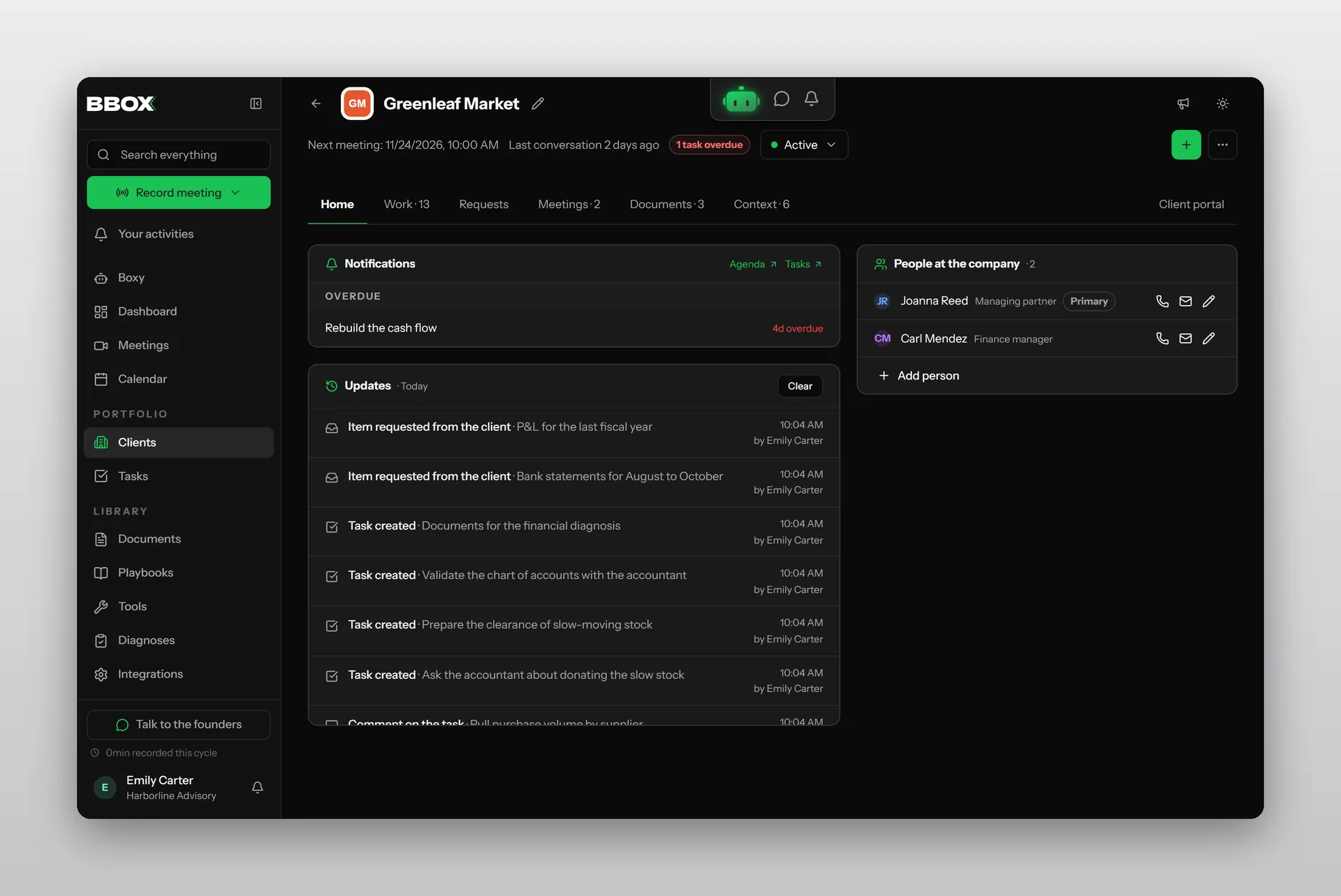
Each client opens on its Home: notifications on one side and, in front, what happened, grouped by day. The timeline is built from what the other parts already record: meetings, task history and requests.
Meetings
A meeting becomes work
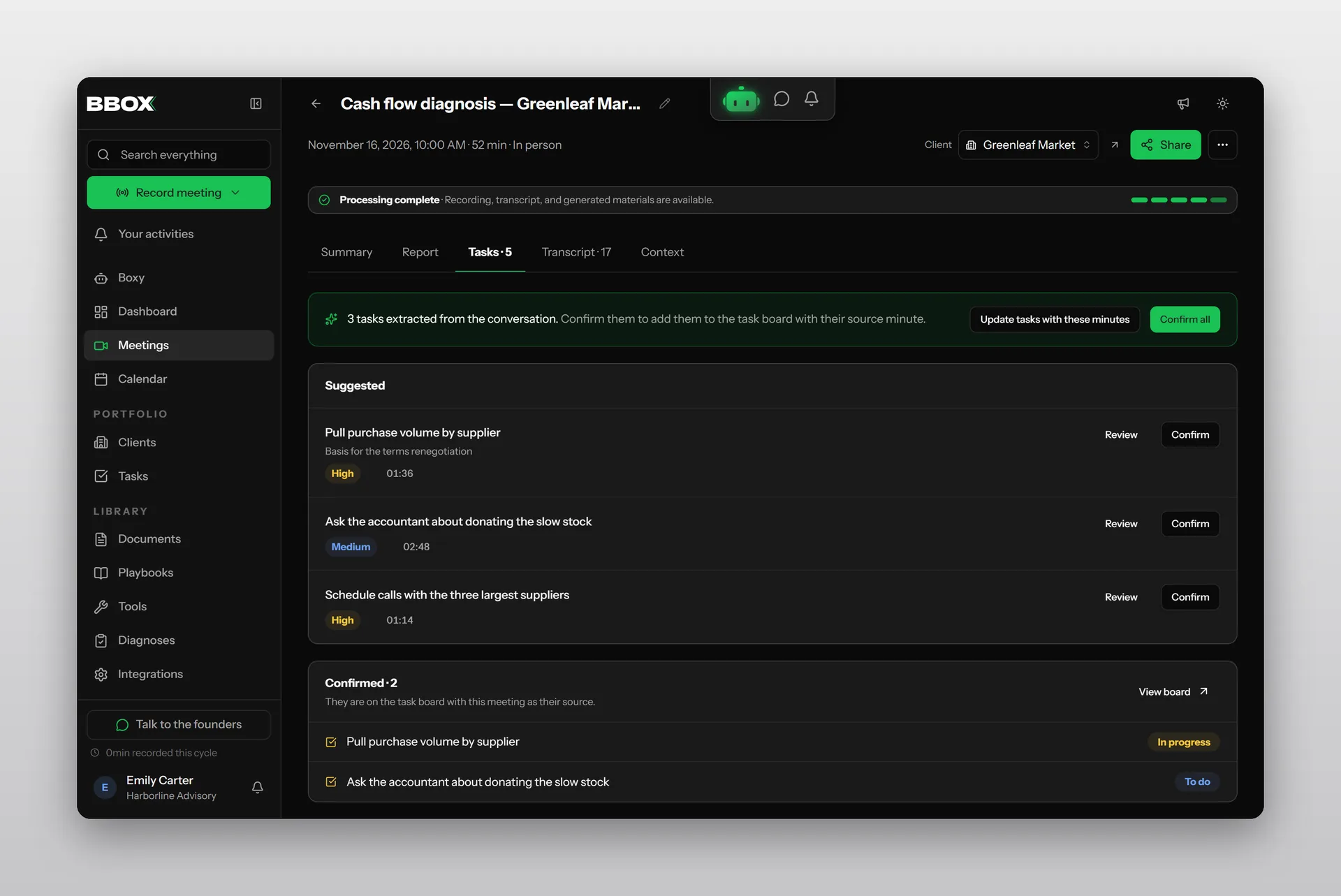
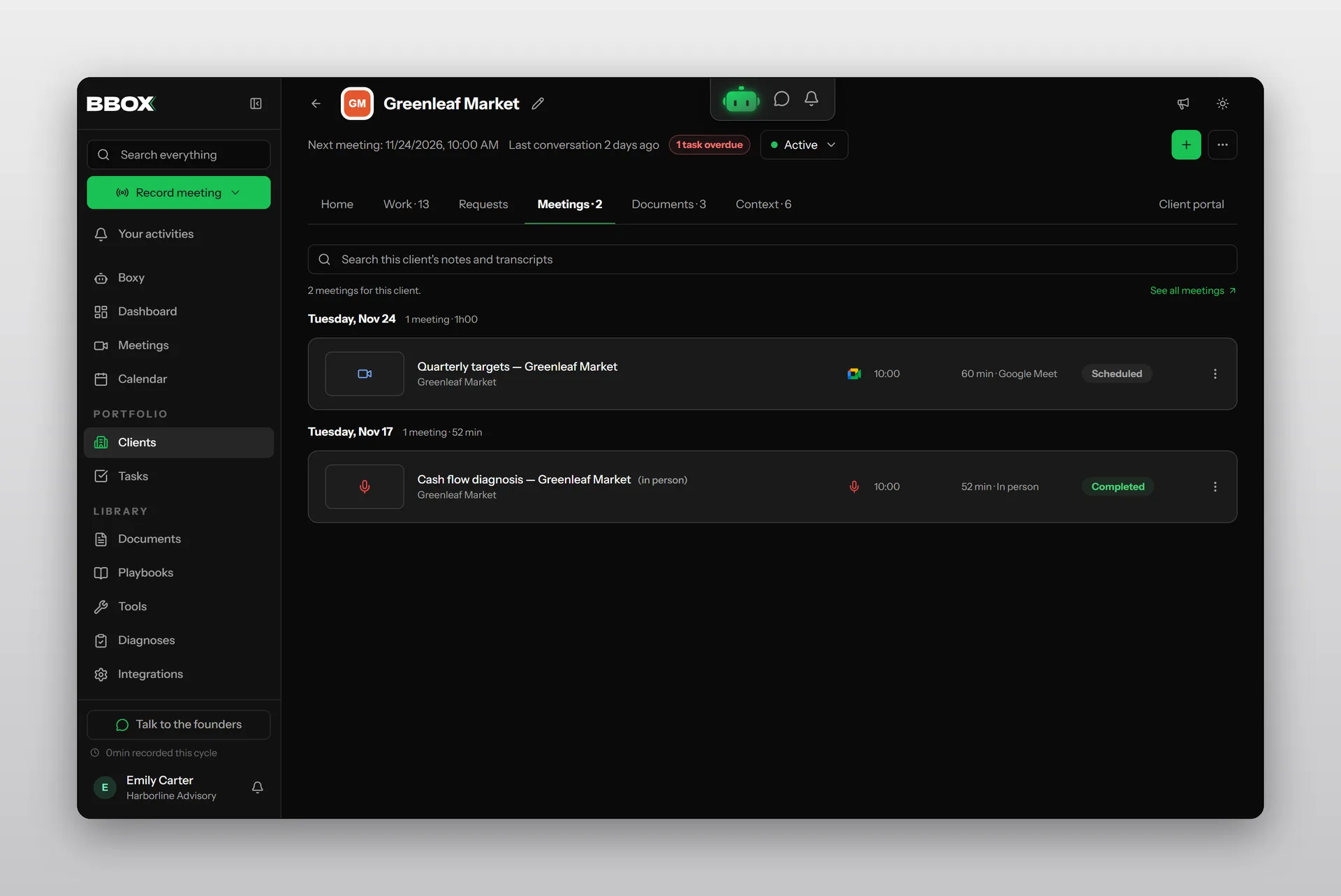
The bot records and transcribes, and the minutes suggest tasks, each with a priority and the minute it came from.
In our first user tests, those tasks went straight to the board. With so many of them arriving after every meeting, the board became an information overload for the consultant.
So I made a person confirm every suggested task before it reaches the board. It costs one click per task, and in return the board only holds work someone agreed to do. Once confirmed, the task carries the meeting as its source.
Deliveries
A playbook becomes a schedule
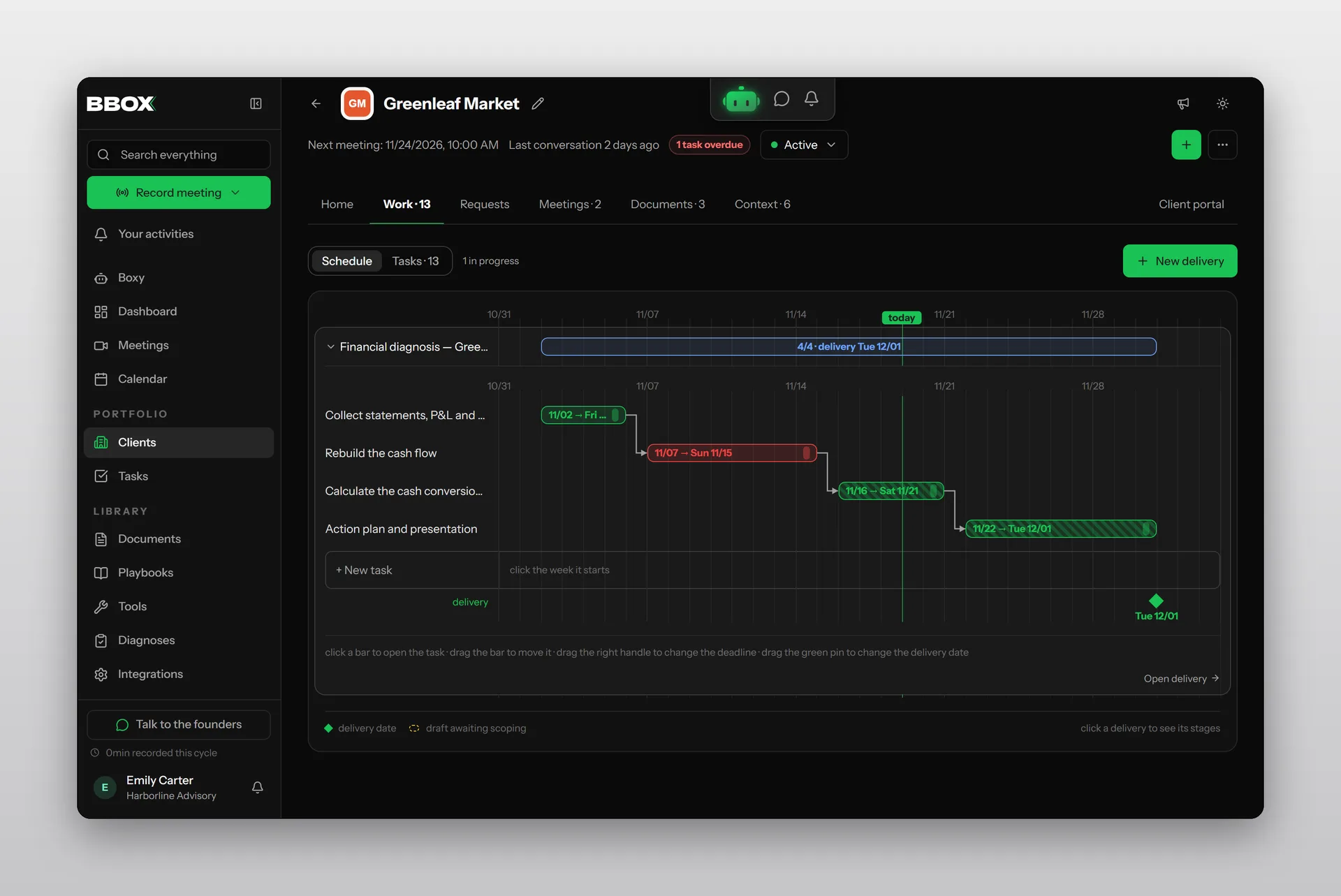
A playbook is the method a delivery copies when it starts: stages, deadlines inside a cycle, a briefing and acceptance criteria. On the client's schedule, the stages become tasks with deadlines and dependencies.
Tasks
One board for every client
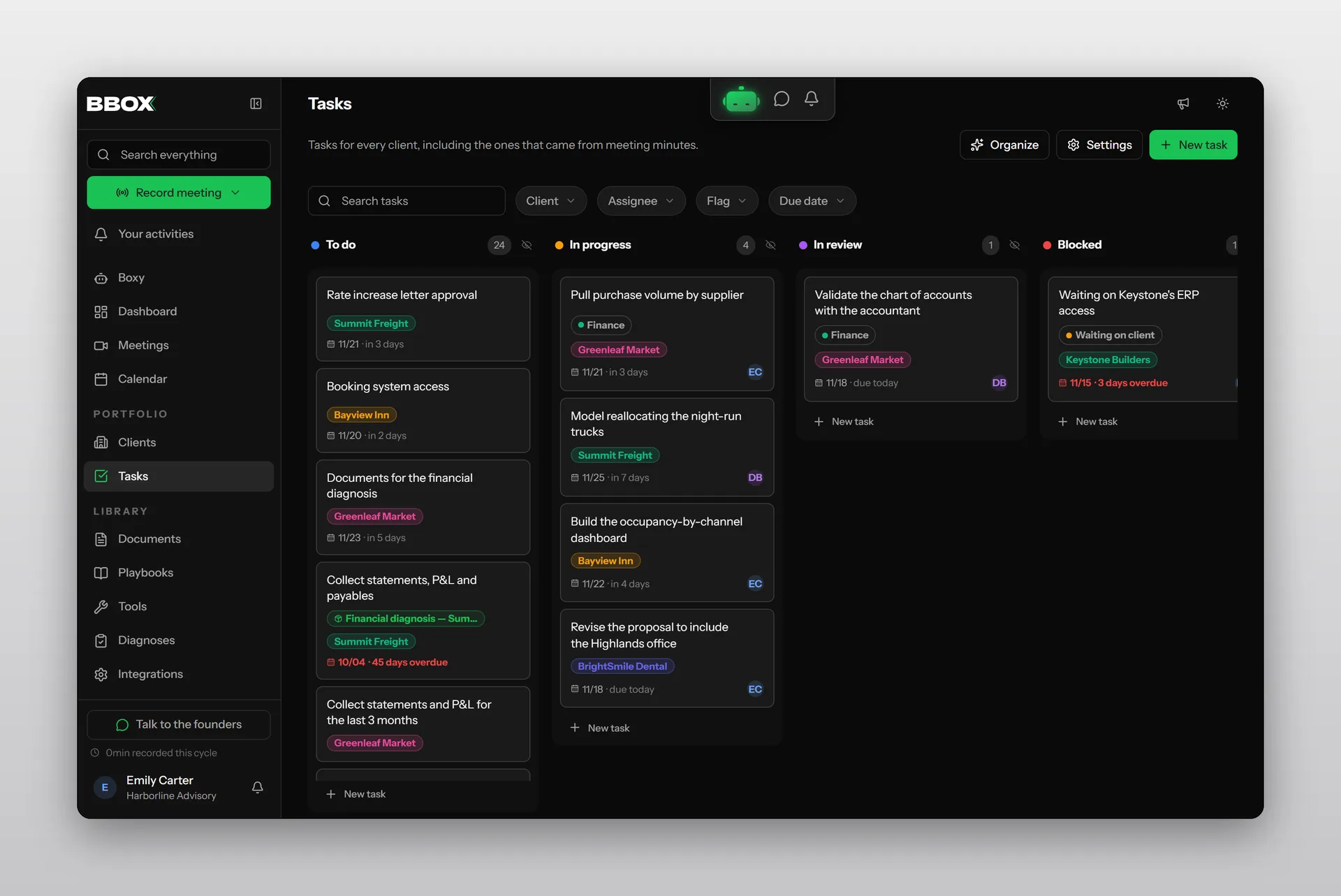
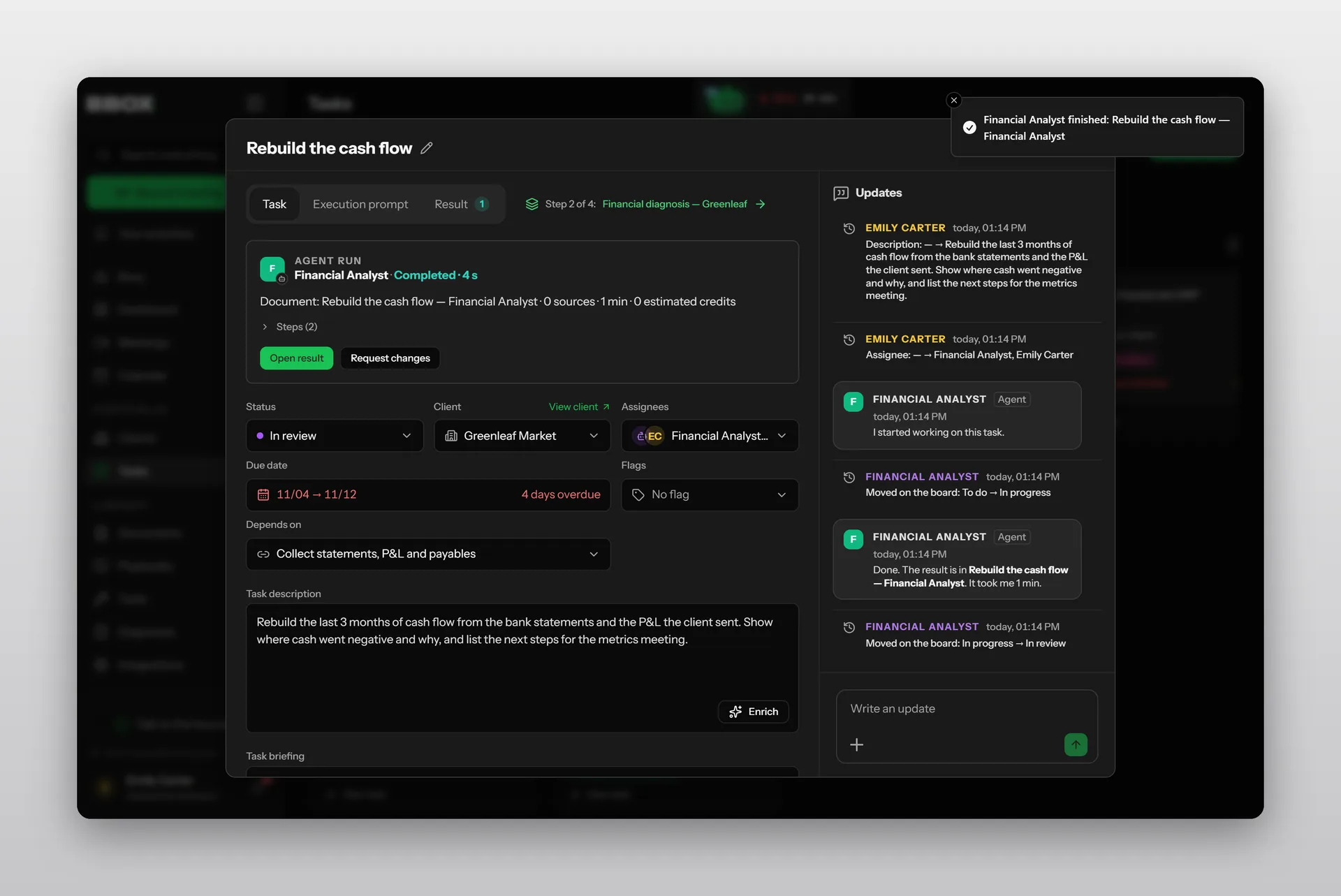
Whatever their origin, tasks land on the same board. A task can be done by a person, by an AI agent or by Claude through the connector, and every path ends in a person's review.
Client portal
The client's side
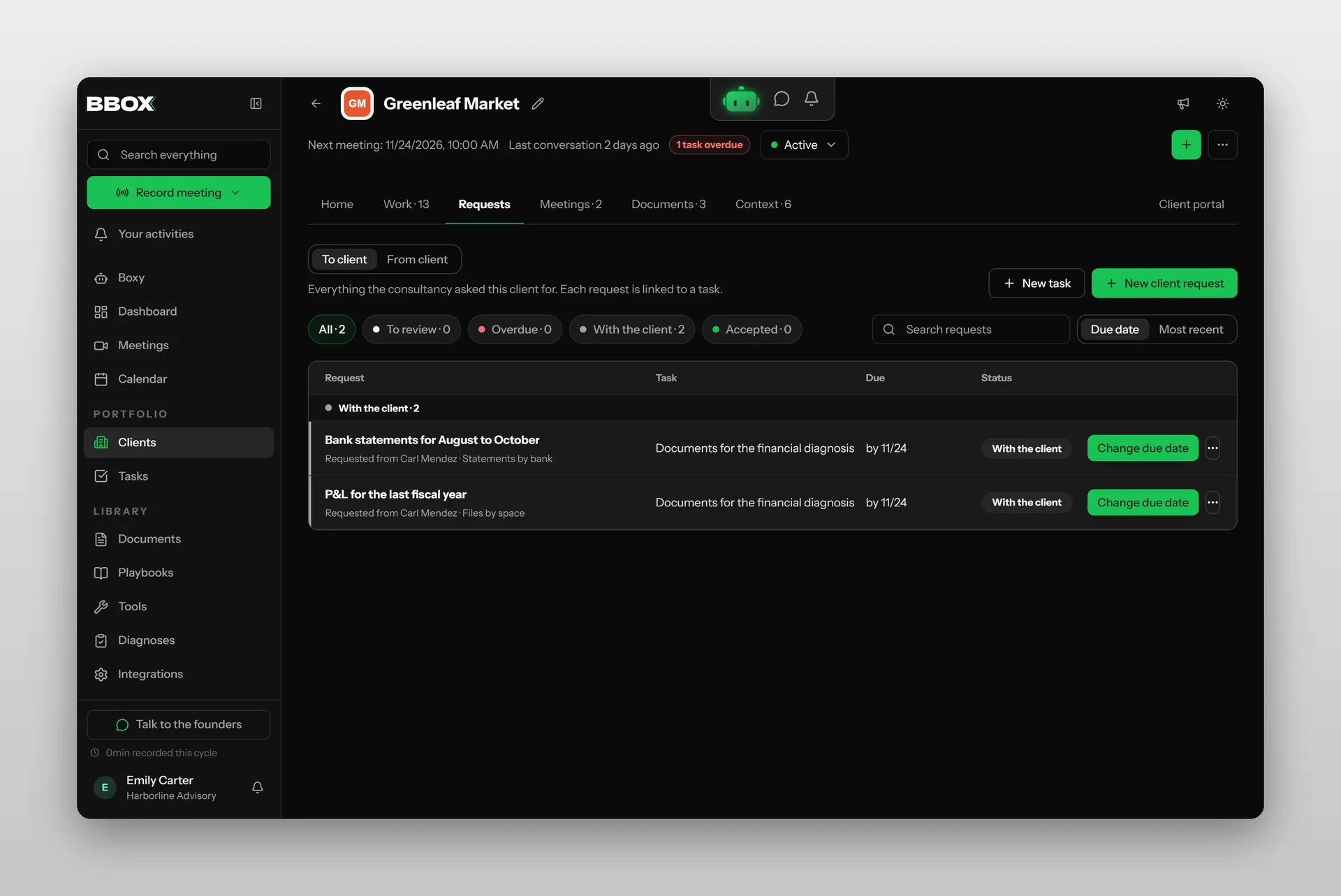
The consultant decides, client by client, which areas of the portal the client sees. Requests go both ways: what the consultancy needs from the client is tied to a task and answered in the portal, and what the client asks for becomes a task once the consultant accepts it.
How I use AI
I took these features from design to code with Claude Code.
- 343: commits of mine on the BBOX codebase since September 23, 2026
- 341: of them with Claude as co-author
Feedback
A consultant who used BBOX in its pilot phase wrote to us (translated from Portuguese):
"Having client portfolio management, meeting records and follow-up, reports, project monitoring and task control in a single platform brought more dynamism, organization and practicality to our operation."
"This ability to listen to the user, understand their needs and turn feedback into improvements is, without a doubt, a great differentiator."
Status
Live in BBOX.